Studying Medicine in Spain: requirements, costs. Guide for students
Spain offers a dynamic academic environment, well-known university cities, public and private institutions and a high standard of medical training.
Studying Medicine in Spain is an increasingly popular option for students who want a medical degree abroad while staying inside Europe. Spain offers a dynamic academic environment, well-known university cities, both public and private institutions, and a higher education system that is part of the European Higher Education Area.
It does not, however, mean avoiding selection. Admission is competitive, and each university may apply its own entry requirements, criteria and deadlines. Applicants need to prepare their academic documents carefully, meet the language requirements and, depending on the institution, sit specific admission tests.
What it means to study Medicine in Spain
The medical degree usually lasts six years. It is designed to train future doctors and to prepare students for the stages that follow: degree recognition, medical registration and, where applicable, practising in Spain or in another European country.
Spain is an attractive destination because it belongs to the European Union, its qualifications are recognised internationally and its university cities offer a strong student life. One point should be clear from the start: Medicine in Spain is not an open-access degree. Places are limited and admission is selective.
Six years of study inside the European Higher Education Area, with limited places and selective admission.
How to get into medical school in Spain
The first thing to understand is the difference between public and private universities, because the two follow very different admission routes.
Public universities
Admission is highly competitive: places are limited and Medicine is often the programme with the highest entry scores. For international applicants the process may involve the recognition, conversion or evaluation of previous qualifications according to the Spanish system — in some cases through UNEDassis, when the university requires it. The final score may depend on the assessment of the academic background and, where applicable, on the results of the Pruebas de Competencias Específicas (PCE).
Private universities
Admission is managed directly by each institution. The selection process may include:
evaluation of the academic record
assessment of previous school performance
Spanish language test
English language test
psycho-aptitude test
motivational interview
verification of the required documents
There is no single admission procedure in Spain Each university may set different requirements, tests, assessment methods and application deadlines. Check them one by one, well before the window opens.
Requirements to study Medicine in Spain
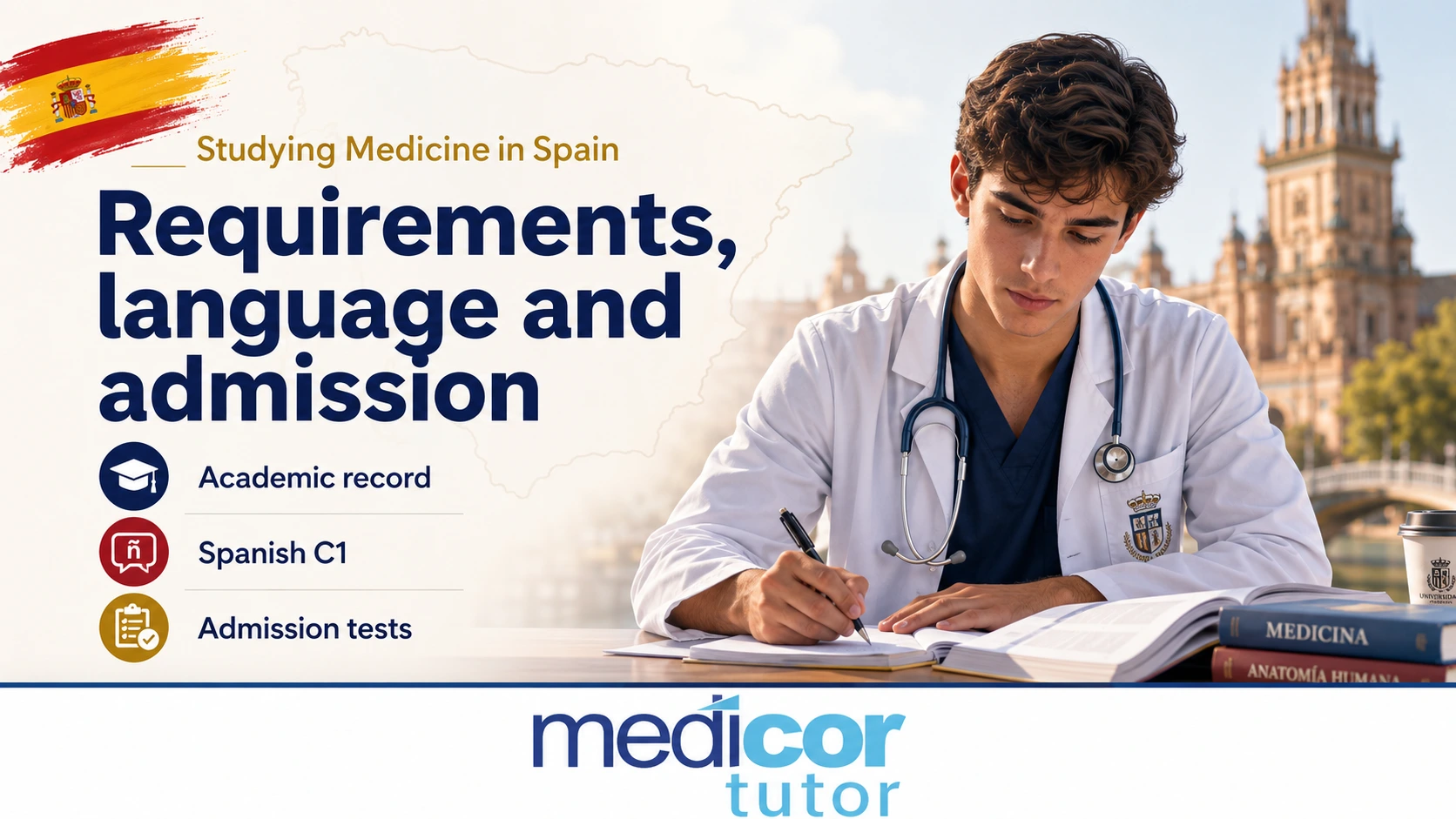
Students must usually meet academic, linguistic and administrative requirements. These vary depending on the university and on whether it is public or private.
High school diploma
Applicants must have completed secondary education. Depending on the university, the diploma may need to be recognised, converted or assessed according to the Spanish education system.
Academic record
Universities may review grades, previous studies and science subjects. A solid background in Biology, Chemistry, Mathematics and Physics is often a real advantage.
Level of Spanish
In most Spanish universities Medicine is taught in Spanish, and international students may be asked to prove an advanced level, often equivalent to C1. Students need to follow lectures, understand scientific texts, sit exams and communicate with patients and healthcare professionals during clinical training.
Language is one of the decisive factors: clinical placements are carried out in Spanish.
Language tests
The admission process may include tests in both Spanish and English. The Spanish test verifies whether the applicant can follow a degree taught in Spanish; the English test is used because a large part of the scientific literature and teaching material is in English.
Psycho-aptitude test
Some universities require a psycho-aptitude test, which may assess logical reasoning, analytical skills, motivation, study attitude, stress management and overall suitability for a demanding degree.
Documents
Identity documents, school certificates, academic transcripts, language certificates, application forms and any additional paperwork requested by the university. Starting early is essential, especially when documents need to be translated, certified or evaluated.
How much does it cost to study Medicine in Spain?
The cost depends on the type of university, the city and the specific programme. At public universities tuition fees are generally lower, but admission is highly competitive and places are limited. At private universities fees are higher and can vary significantly from one institution to another.
Beyond tuition, students should budget for accommodation, food, transport, study materials, health insurance, language courses and administrative expenses. Madrid and Barcelona have the highest living costs, especially for housing; other university cities offer a better balance between quality of life, services and affordability.
Before choosing a university, evaluate not only the annual fee but the full budget for the entire degree.
The best cities to study Medicine in Spain
Madrid International and well-connected, with a broad university offering — but higher living costs, especially for accommodation.
Barcelona Dynamic and multicultural, very attractive to international students, although demand for housing is high.
Valencia A good balance between quality of life, services, climate and more sustainable costs than Madrid or Barcelona.
Murcia A more accessible university city, with a calmer pace of student life.
Pamplona A structured academic environment and a long university tradition.
The choice should not depend only on the reputation of the university. Budget, language, lifestyle, accommodation, transport, student services and clinical training opportunities all matter just as much.
Is Medicine in Spain the right choice for you?
It can be a valuable opportunity for students who want to build a medical career in Europe, but it requires careful planning. Language requirements, admission tests, academic record evaluation, tuition fees, living costs and the choice of university should all be analysed before applying.
Medicor Tutor supports students who want to study Medicine abroad: we help evaluate options, prepare for the admission process and build a realistic strategy to access medical studies across Europe.
Since 2009 we have helped more than 5,000 students and families choose a university in Europe, prepare for the entrance test and settle in. Tell us your grades, budget and language — we will shortlist the universities where an application is realistic.







 Admission TestsNews & PressContacts